Showing posts with label journalist. Show all posts

Wednesday, August 19, 2009

The Faces of Shanghai

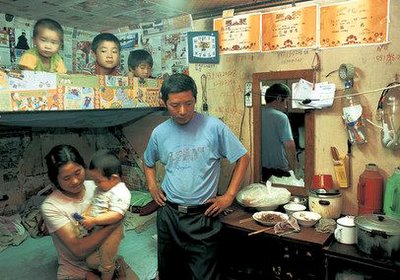
Meet Wei Yufang and his family
魏玉芳 (山东籍 小贩) 我们的日子过得很苦,每顿都是煎饼就着咸菜吃,加上一杯白开水。孩子们想吃荤菜时,就烧一个鸡蛋给他们吃。只要不下雨,就天天早出夜归,每天做十五、六个小时生意。希望孩子们上好学,我那怕东借西凑也要让他们上大学,别象我这样没文化。大儿子很争气,每学期都得奖回家,我很开心。外出摆水果滩被地痞流氓欺负,让我伤心透了。

Wei Yufang (Shandongnese, Vendor): "We are leading a hard life and eat battercakes, pickles and a glass of water for all three meals. When our kids want meat dishes, we cook them an egg. We work more than 15 hours a day if it doesn't rain. We want our kids to be educated and not to live like us. I will risk anything if our kids can go to university. My eldest son is excellent and wins prizes every semester. I suffer being teased by local ruffians."


-:-Look into the faces of Shanghai residents through the lens of Hu Yang-:-

Photojournalist and artist Hu Yang has created a lasting record of Shanghai people in their living quarters. Each individual is introduced to us in their own words (see above). There is a total of 97 documentary photographs.

.

Thursday, August 13, 2009

That certain 'Je ne sais quoi'

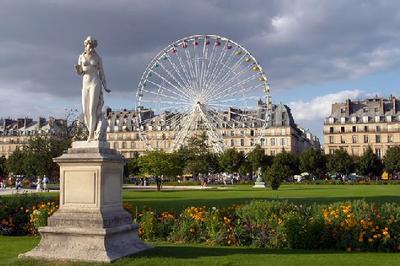
CROSS-CULTURAL OUTLINE visits PARIS: Le Jardin des Tuileries

From The Paris Journals by Michael Howard, Essayist, Commentator and CROSS CULTURAL OUTLINE Contributing Writer

"French police cruise on rollerblades and wear big silver stars copied from western movies. They no longer have the billy clubs and weighted capes with which they were wont to bash students upside the head. Now they carry guns. Dark vans with tinted windows transport them around town to monitor the manifestations. A manifestation is a peaceful, prearranged parade by anybody for any reason. Sometimes the bus and metro workers strike in sympathy and the city shuts down. Cars jam the streets. The police blow whistles and shout at the stalled cars and generally make things worse. Many people take a holiday. The French love holidays and take them all the time."

"Everybody smokes everywhere. Cigarette boxes say "Smoking Kills" in big black letters on one side and "Tobacco Causes Impotence" on the other. A popular item is a cardboard container into which a cigarette pack can be inserted to cover the warnings."

"In Paris everybody does the Paris Walk. If you don't do the Paris Walk, people behind you will knock you down and step over you. The basic step is simple; you just shorten the length of your stride by half and walk twice as fast. Paris is one of the most crowded cities in the world and people walk closely together. You must do The Walk in an absolutely straight line. If you swerve, you will collide with oncoming pedestrians in a domino effect which tumbles walkers for blocks. Parisians can estimate distances in millimeters, which is why they drive the way they do."

"In a crowd you see faces from history. A Voltaire sharp-chin slit-mouth face, a pudgy big-nosed Louis face, a girl with the delicate features of an 18th-century marquise. Noble families who marry carefully can trace their ancestors back to the Norman Conquest."

"This is what happens at a good café in Paris. The owner greets you by name, body-blocks an elderly lady who is heading for your favorite table, asks whether you want the usual (a bottle of St. Véran), brings an extra plate of peanuts, and fills both glasses. Everyone in the café speaks French except the couple at the next table, who are in love and do not speak at all. When you leave, the owner grasps your hand, kisses your wife on both cheeks, and begs you to return."

"This is what happens at a bad café in Paris. You spot a good table for two on the terrace; but seconds before you arrive, a party of Americans steals one of the chairs. Your wife sits in the remaining chair to establish ownership of the table and you stand in front of it while 50 comfortably-seated people stare at you with amused contempt. You feel like a bad stand-up comic. Your wife lights another cigarette and pretends she doesn't know you."

"Finally you find another chair and order wine. The waiter appears with a pot of muscadet and two glasses. He sprinkles your glass with a few drops and pauses reverently, no longer a waiter at the Café Bonaparte but a sommelier presenting a dusty bottle of Grand Cru Chateau Lafite Rothschild to the Minister of Culture. He is in fact only a waiter bearing a carafe containing a vile liquid the color of tap water tinged with piss. Without tasting it, you motion for him to fill both glasses. You do not taste the wine because you are embarrassed. You know that you have ordered the cheapest, most abominable wine on the menu, the glass misty with sludge from the bottom of the keg."

"On your right, two New Yorkers complain about their meal at one of the best restaurants in town. On your left, an ancient British couple cannot understand their menu, which happens to be written in English. With pictures. In the corner, a group of Germans loudly recall their student days in Heidelberg. The waiter overcharges you ten dollars on the bill and later presents his girl friend with the lighter your wife forgot."

.

[Text © Michael Howard ]

[Photo Credit: French MBA Club]

.
Sunday, September 23, 2007

Roundup Remembered

The photographer in action
.
.
.


In 1942,

Dorothea Lange (1895-1965), prominent American photographer and photojournalist, was hired by the War Relocation Authority of the U.S. government to document the evacuation and relocation of Pacific coast Japanese Americans.


Executive Order 9066, authorized by President Franklin Roosevelt, sent 120,000 civilians of Japanese ancestry to various detention and concentration camps with armed guards and barbed wire.


Just one of the camps

This was an immediate and drastic response to the Japanese surprise attack on Pearl Harbor on December 7, 1941.

Strong sentiments of prejudice and dehumanization of "Japs" in the general population were fueled by anti-Japanese propaganda during World War II.
These hateful sentiments were extended indiscriminately toward the enemy forces along the South Pacific battle lines as well as, unjustifiably, toward the peaceful and loyal citizenry of Japanese Americans at home in the U.S.


Proclamation from up high


Mother and child are tagged

When justice fails

Up and down the West Coast, Japanese Americans, from doctors to shopkeepers, to farmers right down to school children and babies were summoned. The majority did not even speak Japanese, only English. All pledged their loyalty to the United States, their homeland, but to no avail:


Entire communities of Japanese American families were rounded up and herded into horse stalls at the Tanforan Assembly Center in Northern California. There they were inventoried and tagged and held for up to six months at what had been a racetrack before being transported to more permanent camps in the deserts of Arizona, Utah and New Mexico and other remote locations, such as North Dakota and Arkansas. One of the first things the prisoners did was form baseball leagues to pass the time while in captivity.


Dorothea Lange's photographs vividly denounce this cruel, hysterical and racist policy. Her lens captured the quiet dignity of the forgotten men, women and children even as their lives were tossed into turmoil and deprivation.
:


Queuing up to be processed

Over 90% of Dorothea Lange's documentary photos were suppressed and never published until much later.


Proud Grandfather in captivity


Although she did not live to know it, 23 years after her death her photographs would help remind a nation of its tragic wrongdoings and might have contributed, in some small measure, to the passing of the Civil Liberties Act of 1988, a United States federal law that granted reparations to Japanese-Americans who had been interned by the United States government during World War II.


Beginning in 1990, the government paid reparations to surviving internees.


[Read an interview with Dorothea Lange]


[See also: Discrimination]


[Related Abu Ghraib]

.

Friday, August 10, 2007

Inadvertent Discrimination

:

"Most people, no doubt, when they espouse human rights,

make their own mental reservations

about the proper application

of the word 'human',"

Lafollette, Suzanne (1893-1983), American Journalist

:

Référencement

© 2009 CROSS-CULTURAL OUTLINE, an independent online publication. All rights reserved.
lesen