Showing posts with label lives. Show all posts

Wednesday, August 19, 2009

The Faces of Shanghai

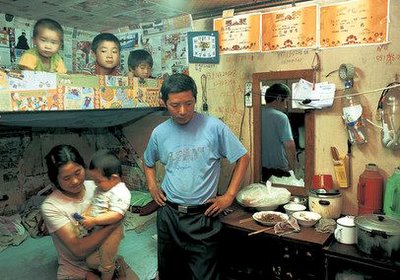
Meet Wei Yufang and his family
魏玉芳 (山东籍 小贩) 我们的日子过得很苦,每顿都是煎饼就着咸菜吃,加上一杯白开水。孩子们想吃荤菜时,就烧一个鸡蛋给他们吃。只要不下雨,就天天早出夜归,每天做十五、六个小时生意。希望孩子们上好学,我那怕东借西凑也要让他们上大学,别象我这样没文化。大儿子很争气,每学期都得奖回家,我很开心。外出摆水果滩被地痞流氓欺负,让我伤心透了。

Wei Yufang (Shandongnese, Vendor): "We are leading a hard life and eat battercakes, pickles and a glass of water for all three meals. When our kids want meat dishes, we cook them an egg. We work more than 15 hours a day if it doesn't rain. We want our kids to be educated and not to live like us. I will risk anything if our kids can go to university. My eldest son is excellent and wins prizes every semester. I suffer being teased by local ruffians."


-:-Look into the faces of Shanghai residents through the lens of Hu Yang-:-

Photojournalist and artist Hu Yang has created a lasting record of Shanghai people in their living quarters. Each individual is introduced to us in their own words (see above). There is a total of 97 documentary photographs.

.

Sunday, September 23, 2007

Roundup Remembered

The photographer in action
.
.
.


In 1942,

Dorothea Lange (1895-1965), prominent American photographer and photojournalist, was hired by the War Relocation Authority of the U.S. government to document the evacuation and relocation of Pacific coast Japanese Americans.


Executive Order 9066, authorized by President Franklin Roosevelt, sent 120,000 civilians of Japanese ancestry to various detention and concentration camps with armed guards and barbed wire.


Just one of the camps

This was an immediate and drastic response to the Japanese surprise attack on Pearl Harbor on December 7, 1941.

Strong sentiments of prejudice and dehumanization of "Japs" in the general population were fueled by anti-Japanese propaganda during World War II.
These hateful sentiments were extended indiscriminately toward the enemy forces along the South Pacific battle lines as well as, unjustifiably, toward the peaceful and loyal citizenry of Japanese Americans at home in the U.S.


Proclamation from up high


Mother and child are tagged

When justice fails

Up and down the West Coast, Japanese Americans, from doctors to shopkeepers, to farmers right down to school children and babies were summoned. The majority did not even speak Japanese, only English. All pledged their loyalty to the United States, their homeland, but to no avail:


Entire communities of Japanese American families were rounded up and herded into horse stalls at the Tanforan Assembly Center in Northern California. There they were inventoried and tagged and held for up to six months at what had been a racetrack before being transported to more permanent camps in the deserts of Arizona, Utah and New Mexico and other remote locations, such as North Dakota and Arkansas. One of the first things the prisoners did was form baseball leagues to pass the time while in captivity.


Dorothea Lange's photographs vividly denounce this cruel, hysterical and racist policy. Her lens captured the quiet dignity of the forgotten men, women and children even as their lives were tossed into turmoil and deprivation.
:


Queuing up to be processed

Over 90% of Dorothea Lange's documentary photos were suppressed and never published until much later.


Proud Grandfather in captivity


Although she did not live to know it, 23 years after her death her photographs would help remind a nation of its tragic wrongdoings and might have contributed, in some small measure, to the passing of the Civil Liberties Act of 1988, a United States federal law that granted reparations to Japanese-Americans who had been interned by the United States government during World War II.


Beginning in 1990, the government paid reparations to surviving internees.


[Read an interview with Dorothea Lange]


[See also: Discrimination]


[Related Abu Ghraib]

.

Sunday, September 16, 2007

Look and Listen

CAN you look him in the eye

can YOU look him in the eye

can you LOOK him in the eye

can you look HIM in the eye

can you look him IN the eye

can you look him in THE eye

can you look him in the EYE


CAN you re member his mess age

can YOU re member his mess age

can you RE member his mess age

can you re MEMBER his mess age

can you re member HIS mess age

can you re member his MESS age

can you re member his mess AGE


Commentary

The anger and condemnation in the kid's voice is entirely justified. We were not the first to pollute and damage our planet. That process started along with the industrial revolution. We are, however, the first to have scientifically researched and assessed the devastating scope and consequence of global warming. Despite this knowledge we have failed take crucial countermeasures.

Our guilt is that of denial, inertia, lack of responsibility and near-criminal neglect. We have sold out to the instant gratification of consumerism, no matter the cost, and to the mind-numbing falsehoods of a morally bankrupt leadership.

Time has come to face up to the undeniable reality of climate change and to join in taking effective steps to halt and maybe even reverse it. The ways and means to accomplish this objective are already at our disposal waiting to be enacted and applied.

Not only do we owe this to our kids, we owe it to ourselves.


[See also: Preserve our eco-system]

.

Thursday, September 6, 2007

The Lives of Others

:

CROSS CULTURAL OUTLINE Film Pick


CROSS CULTURAL OUTLINE recommends

Das Leben der Anderen

Dieser gründlich recherchierte Film von Florian Henckel von Donnersmarck erzählt von der Verlorenheit des Individuums im erbarmungslosen System der Kontrolle und Überwachung. Ost-Berlin, November 1984, fünf Jahre vor der Öffnung der Berliner Mauer. Hier spielt das Drama über Verhörspezialist Stasi-Hauptmann Gerd Wiesler (Ulrich Mühe), der im Verlauf seiner Spitzelei an sich selbst zu zweifeln beginnt. Dieser Zweifel an seinem Auftrag und an der Staatsmacht der DDR schlechthin wächst, bis er ihn letztendlich in hoch riskante Tat umsetzt.

Ein eindringliches, spannendes Drama um Liebe, Leidenschaft und Mut, und um die ewige Faszination der Freiheit, das in 2006 mit einem Oscar ausgezeichnet wurde.

CROSS CULTURAL OUTLINE awards 5 stars


The outstanding German character actor Ulrich Mühe
Der Schauspieler Ulrich Mühe starb am 22. Juli 2007 in Walbeck, Sachsen-Anhalt, an Magenkrebs.

Sein letzter großer Erfolg war die Hauptrolle in dem Oscar-prämierten Film "Das Leben der Anderen".


The outstanding actor who portrayed the main character, Stasi agent Gerd Wiesler, in the oscar winning German thriller/drama "The Lives of Others" died in July from cancer of the stomach.


CROSS-CULTURAL OUTLINE featured film:


The Lives of Others


Now defunctGerman director Florian Henckel von Donnersmarck debuts with his feature The Lives of Others, which earned an Oscar for Best Foreign Language Film in 2006.

The film is set in 1984 East Berlin five years before the fall of the Berlin Wall. It provides an exquisitely nuanced exposé of life in a totalitarian regime. The main character, Gerd Wiesler, played by Ulrich Mühe, is a secret police (Stasi) surveillance expert trained to perpetuate the oppressiveness and the lack of freedom in communist East Germany, the former GDR. His professional stoicism gradually melts as he becomes swept up in the lives of the artistic community he is spying on. Eventually, he secretly and heroically intervenes in the outcome of his investigation.

This role had particular resonance for Mühe, who was himself under surveillance by the Stasi at the time he was a star of East German theater.


[Read about Ulrich Mühe in Der Spiegel (in German)]


::Have you seen this film? Post your review under "Comments"::

Référencement

© 2009 CROSS-CULTURAL OUTLINE, an independent online publication. All rights reserved.
lesen