Showing posts with label life. Show all posts

Saturday, August 8, 2009

Jungle in a Pot

Here you are, at home, sitting at your computer. Take a look around you: Is there any green you can rest your eyes on? Chances are, there is not.

Not everyone has a picture window with a view of a lush garden, park or copious greenery. For most of us, the view is that of the building across the street, or of the bus-stop, or of rooftops, or of the neighbor's garage, or of the fence around the adjacent property, all of them tiresome and drab.

And here we sit, pounding away at the keyboard, squinting at the screen, boxed in by walls, real or imagined. Time to make your space more user-friendly by adding a bit of green.

GREEN is GOOD for you!
Asparagus densiflorus 'Sprengeri',
or Sprenger's Asparagus Fern

is an evergreen perennial with delicate needlelike leaves and ferny green arching or cascading branches. It is extremely hardy and thrives not just outdoors, but in containers as a houseplant or on a window sill.

This plant is inexpensive. Of all the possible houseplants, it does not require that you have the proverbial 'green thumb', as long as you pour a glass of water in the pot now and again to keep the soil moist. Asparagus Ferns are very forgiving and do not need direct sunlight. They do, however, need a nearby light-source if grown indoors (preferably near a window). This plant is the perfect option for your office, your home office, your apartment or your room.
-:- It is, what we might call, a cross-cultural plant -:-

Whether you are in Johannesburg, Munich, Chicago or Caracas, or anywhere in-between, go ahead, bring an Asparagus Fern into your life to brighten your 'interiorscape'. Your overworked eyes and stressed-out mind will thank you for it. And, who knows, pretty soon you might add a second plant, or a third to make your own private jungle.

(Fine print: No, we are not commercial growers or salesmen. We simply report on what works best in a given situation based on our own experience.)

Do you have a favourite houseplant? Tell us what it is.

.

Monday, September 29, 2008

A Tribute to TONY VAUGHAN by Ana Elsner

Ana Elsner pays tribute to poet and musician TONY VAUGHAN
:

On the night of September 27, 2008, the San Francisco literary community lost one of its most forthright, giving, gentle and beloved members, the poet, artist and musician


Tony Vaughan

(July 14, 1947 - September 27, 2008)
.

Cancer struck him down and took him from us, but his courageous spirit and his compassion for all living things lives on in his legacy of poems and paintings and in the hearts of all who knew him. We publish here a poem that was written by his fellow poet ANA ELSNER and is a tribute to Tony, his life and work, and his sojourn on this earth.


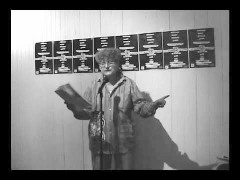
(Photo above: Tony Vaughan performs at the UCSF Cancer Center, Healing Garden Music Series)
::


TONY VAUGHAN
by Ana Elsner


so much
so much
LIFE,

so much
so much
LIVED;

hard
jabs
heart
break

the tyranny
of love and tenderness
transcended,
transcending,
and lapping
at the shore of consciousness;

this valiance
of gingerly rebelling against
the intimacy
of a merciless reality

in soft words
in gentle song
in pastels
on paper;

drifting

on a whiff of the herb,
on a whim of the soul,
on the threadbare sole
of street-corner anonymity
and bus-stop penance;

retracing your footprints,
embedded
in the un-cured clay of mind,

and always seeking by feel,
by feel;

wagering in the currency
of song,
of poem,
of shape and color,
pinned-down,

at times half-veiled in riddles
and distant echoes,

yet decoded to all those
who hold the key of
shared mysticism and wonderment.

You navigated
the un-fathom-able BEING of it all
with stubborn tenacity

while doing battle with the ever-present
specter of resignation.

You kept on moving,
kept on riding the rails,
kept on strumming your guitar,
perhaps to an inattentive crowd,

kept on sketching and re-sketching
the outer reaches
of self.

I call you POET

I call you FRIEND

I call you BROTHER


I RECOLLECT YOU


© Ana Elsner


A reading by Ana Elsner
One of the poems that Ana Elsner reads
in this video recording
is her poem Tony Vaughan

[Click image above to play video]


-:-

At a gathering of friends Ana Elsner reminisces:

"I see Tony sitting across from me at a table outside Café Trieste. I don't remember him ever sitting inside the café. Always outside, with his hat on. He has just taken his guitar out of the beat-up case and cradles it in his lap, while continuing our conversation. Then, almost subconsciously, he fingers a few riffs. He tells me about his novel and the ongoing struggle he has with it, a sort of love/hate relationship with (his) life. I buy him a glass of wine. Later we walk a few steps up Vallejo Street to where the steep alley goes down to Broadway and share a smoke. We are not in a hurry. It's only late afternoon. A fogbank is pouring over the top of Russian Hill. We shiver just a little. But we don't care."
-:-

Ana Elsner remembers George Tsongas, another poet who was dear to her.

.

Sunday, September 16, 2007

Look and Listen

CAN you look him in the eye

can YOU look him in the eye

can you LOOK him in the eye

can you look HIM in the eye

can you look him IN the eye

can you look him in THE eye

can you look him in the EYE


CAN you re member his mess age

can YOU re member his mess age

can you RE member his mess age

can you re MEMBER his mess age

can you re member HIS mess age

can you re member his MESS age

can you re member his mess AGE


Commentary

The anger and condemnation in the kid's voice is entirely justified. We were not the first to pollute and damage our planet. That process started along with the industrial revolution. We are, however, the first to have scientifically researched and assessed the devastating scope and consequence of global warming. Despite this knowledge we have failed take crucial countermeasures.

Our guilt is that of denial, inertia, lack of responsibility and near-criminal neglect. We have sold out to the instant gratification of consumerism, no matter the cost, and to the mind-numbing falsehoods of a morally bankrupt leadership.

Time has come to face up to the undeniable reality of climate change and to join in taking effective steps to halt and maybe even reverse it. The ways and means to accomplish this objective are already at our disposal waiting to be enacted and applied.

Not only do we owe this to our kids, we owe it to ourselves.


[See also: Preserve our eco-system]

.

Thursday, September 6, 2007

The Lives of Others

:

CROSS CULTURAL OUTLINE Film Pick


CROSS CULTURAL OUTLINE recommends

Das Leben der Anderen

Dieser gründlich recherchierte Film von Florian Henckel von Donnersmarck erzählt von der Verlorenheit des Individuums im erbarmungslosen System der Kontrolle und Überwachung. Ost-Berlin, November 1984, fünf Jahre vor der Öffnung der Berliner Mauer. Hier spielt das Drama über Verhörspezialist Stasi-Hauptmann Gerd Wiesler (Ulrich Mühe), der im Verlauf seiner Spitzelei an sich selbst zu zweifeln beginnt. Dieser Zweifel an seinem Auftrag und an der Staatsmacht der DDR schlechthin wächst, bis er ihn letztendlich in hoch riskante Tat umsetzt.

Ein eindringliches, spannendes Drama um Liebe, Leidenschaft und Mut, und um die ewige Faszination der Freiheit, das in 2006 mit einem Oscar ausgezeichnet wurde.

CROSS CULTURAL OUTLINE awards 5 stars


The outstanding German character actor Ulrich Mühe
Der Schauspieler Ulrich Mühe starb am 22. Juli 2007 in Walbeck, Sachsen-Anhalt, an Magenkrebs.

Sein letzter großer Erfolg war die Hauptrolle in dem Oscar-prämierten Film "Das Leben der Anderen".


The outstanding actor who portrayed the main character, Stasi agent Gerd Wiesler, in the oscar winning German thriller/drama "The Lives of Others" died in July from cancer of the stomach.


CROSS-CULTURAL OUTLINE featured film:


The Lives of Others


Now defunctGerman director Florian Henckel von Donnersmarck debuts with his feature The Lives of Others, which earned an Oscar for Best Foreign Language Film in 2006.

The film is set in 1984 East Berlin five years before the fall of the Berlin Wall. It provides an exquisitely nuanced exposé of life in a totalitarian regime. The main character, Gerd Wiesler, played by Ulrich Mühe, is a secret police (Stasi) surveillance expert trained to perpetuate the oppressiveness and the lack of freedom in communist East Germany, the former GDR. His professional stoicism gradually melts as he becomes swept up in the lives of the artistic community he is spying on. Eventually, he secretly and heroically intervenes in the outcome of his investigation.

This role had particular resonance for Mühe, who was himself under surveillance by the Stasi at the time he was a star of East German theater.


[Read about Ulrich Mühe in Der Spiegel (in German)]


::Have you seen this film? Post your review under "Comments"::


Wednesday, August 29, 2007

Hermann Hesse on Learning

CROSS CULTURAL OUTLINE recommends the novels by Hermann Hesse


Lesen ohne Liebe, Wissen ohne Ehrfurcht, Bildung ohne Herz, das sind die schlimmsten Sünden gegen den Geist.

- Hermann Hesse, deutsch-schweizerischer Lyriker, Essayist, Erzähler und Kritiker (1877-1962)


Reading without love, knowledge without tribute, education without heart, those are the worst sins against the mind.

- Hermann Hesse, German-Swiss poet, essayist, novelist and critic

(Translation by Ana Elsner)


Published in many languages, Hesse is best known for his works:

Siddhartha, an allegorical novel about the search for enlightenment, first published in 1922,

Steppenwolf, a demonstration of the duality of human nature, pub. 1928,

and The Glass Bead Game (Das Glasperlenspiel), a futuristic novel, describing how people construct, deconstruct, signify, encode and program their perception of reality, pub. 1943.


"The above quote of Hesse reminds me of his novel Unter dem Rad, where the protaganist's spirit is crushed by the rigid educational system of the day.

Hesse's short stories called Märchen deal with the artist's struggle to create great art. They are told in painstakingly beautiful detail and sometimes with humor and irony.

Hesse is one of the greatest psychological novelists since Dostoyevsky. He was a manic-depressive who was not afraid to delve into the depths of his soul. One can clearly see the influence that Jungian psychology had on his work.

In his novel Narcissus and Goldmund, the two protagonists embody the two necessary components of the creative spirit: logic/abstract thought balanced with intuition/emotion. Narcissus, the ascetic monk, is of the Father world coming to terms with the processes of individuation through his intellect. Goldmund, the woodcarving icon artist, is of the Mother world feeling his way through life in the quest for discovering his true Self. This novel is literally steeped in Jungian archetypes and dream symbols on just about every page.

Applying the Riso-Hudson enneagram personality theory, Narcissus represents the five (the Thinker) and Goldmund the four (the Artist) on the scale of personality types. It is no surprise that Hesse, himself, was a four with a five wing."

Vincent Russo, Composer, Orchestrator and Conductor


[Take your own Personality Test]

.

Tuesday, August 21, 2007

Sit and ponder this

-:- -:- -:- -:- -:- -:- -:- -:- -:- -:- -:- -:- -:- -:- -:-


Silent Despair

I Sit and Look Out

I sit and look out upon all the sorrows of the world,
and upon all oppression and shame;
I hear secret convulsive sobs from young men, at anguish with themselves, remorseful after deeds done;
I see, in low life, the mother misused by her children,
dying, neglected, gaunt, desperate;
I see the wife misused by her husband -
I see the treacherous seducer of young women;
I mark the ranklings of jealousy and unrequited love,
attempted to be hid -
I see these sights on the earth;
I see the workings of battle, pestilence, tyranny -
I see martyrs and prisoners;
I observe a famine at sea - I observe the sailors
casting lots who shall be kill’d,
to preserve the lives of the rest;
I observe the slights and degradations
cast by arrogant persons upon laborers,
the poor, and upon negroes, and the like;
All these -
All the meanness and agony without end,
I, sitting,
look out upon,
see, hear, and am silent.

-Walt Whitman, (1819-1892),
American humanist, poet, journalist, editor, teacher, and clerk at the U.S. Department of the Interior


Visit the world of Ana Elsner, a contemporary poet who was inspired by Walt Whitman

.

Tuesday, August 14, 2007

Now as Then - A Message

Bible Quote

In Ephesians 6:12 the Apostle Paul (A.D. 10 - A.D. 67) wrote:

For we wrestle not against flesh and blood, but against principalities, against powers, against the rulers of the darkness of this world, against spiritual wickedness in high places.

[See also: Learn From History]

.

Friday, August 10, 2007

Get a grip on Time

CROSS CULTURAL OUTLINE is on all continents and in all timezones
Clockface hip-hops away the hours, dancing to the rhythm of day and night.

He skips and jumps from continent to continent, humming a different tune, telling a different time. To pin him down on his journey around the globe there is a handy device, the Time Zone Converter.

Say, you're in New York and want to know what time it is in Tokyo, click here.

For an overview of local time in major cities and countries around the world at any given moment, consult The World Clock and...

... Get a grip on Time!

.

Thursday, August 9, 2007

MOKU - The New Haiku by Ana Elsner

:
Moku stands for "modified haiku" and was established by contemporary poet Ana Elsner. It has three lines, the same as haiku, but allows for more syllables per line. Ana Elsner's moku present rich and condensed imagery, illuminating moments in everyday life or interpreting existing conditions or human nature at large, - Commentator


Window Number Nine

screeching siren ambulance

rents in half congested one way street

trailer of uncertain fate

© Ana Elsner


.
Visit
Ana Elsner's website
to see her biography, read her poems and watch video clips of her readings.

.

Référencement

© 2009 CROSS-CULTURAL OUTLINE, an independent online publication. All rights reserved.
lesen